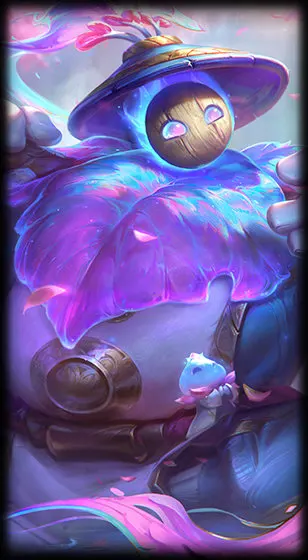
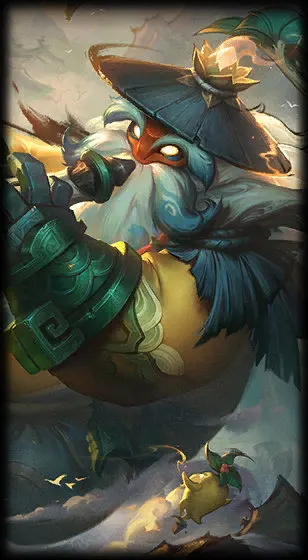
Few supports in League of Legends are as unorthodox as Bard. His difficulty rating of 9 has little to do with mechanical execution and everything to do with how completely his kit ignores conventional laning. He is primarily a roaming support, with the occasional experiment in mid lane.
Traveler’s Call drives nearly all of his movement around the map. Chimes appear across the jungle, and each one he gathers strengthens his meeps, the little spirits that add magic damage to his auto attacks and eventually burst in an area to slow enemies. The result is a constant push and pull: Bard has to leave lane in order to grow, so skilled players treat every chime route as an opportunity to roam, place a ward or set up an ambush, whereas weaker players just leave their carry alone.
A Toolkit of Map Tricks
Cosmic Binding is his main playmaking tool, a missile that slows the first enemy it hits and stuns them if it pins them to a wall or to another enemy, so terrain and positioning matter a great deal. Caretaker’s Shrine drops healing pickups that grow stronger the longer they sit, keeping allies topped up even when Bard is elsewhere. Magical Journey creates a one-way portal through the terrain that either team can use, which allows escapes, flanks and the occasional catastrophic mistake.
Tempered Fate is one of a kind in the game: it freezes everything inside its area, including champions, minions, monsters and even turrets. In skilled hands it isolates targets, interrupts channels or gives a dive the time it needs; used carelessly, it can hand the enemy team the fight. Bard suits inventive players who prize map pressure and improvisation over strict lane discipline.


 P
 Q
 W
 E
 R











 Keria

 Mikyx

 Labrov

 Busio


 Erha